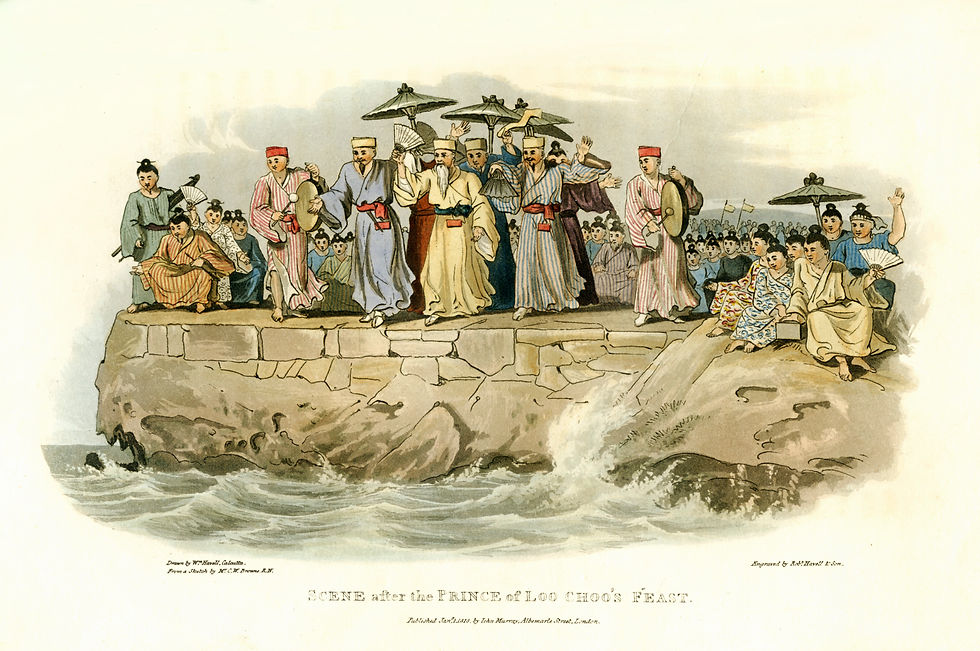
An early nineteenth-century British voyager, Captain Hall, published in 1818 an account of
his landing at Okinawa Island and encounter with the court nobility of what was still at
that time the Kingdom of the Ryukyus: Account of a Voyage of Discovery to the West
Coast of Corea and the Great Loo-Choo [Ryûkyû] Island in the Japan Sea. My paper
in History and Anthropology asks: Why did the Ryukyuans respond to the unannounced entry into their waters by two British naval ships by a seemingly boundless hospitality? With a sideline view on the Sahlins-Obeyesekere controversy, the author proposes that even as the Ryukyuans were eulogizing the entry of the British by showering them with one-sided attention and acknowledging their royal credentials, they tried at the same time to make a bid for their
departure. They might have been deploying ritual techniques apparent still today: of welcoming and (subsequent) sending-off in one single act.
History and Anthropology, 2015
Vol. 26, No. 5, 553–575, http://dx.doi.org/10.1080/02757206.2015.1086998
The Ryukyu chain, the southernmost extension of the Japanese archipelago, has a rich material and festival culture dating back to the Ryukyu Kingdom, which ceased to exist in 1878. Ninety-seven years after Yonaguni Island was fully integrated into Japan, I began my ethnographic fieldwork there, focusing on this tradition.
As a social anthropologist and museum curator, I took notes, photos, and audio recordings, and sometimes melded such engagements into museum exhibits. I cooperated with practitioners of traditional Okinawan crafts in collecting artifacts. A 2019 issue of Arts of Asia presents the Asia collections at the Oslo University Museum of Cultural History, including my article on the still-vibrant festival traditions of islands in southern Okinawa.
I introduce the festival masks and emblems that are essential as identity markers for people in the area. These are produced by Mr. Hiroshi Arashiro, the head of a house with stakes (across the generations) in the makeup of festivals on Ishigaki Island. The mask reproduced below (©Museum of Cultural History, University of Oslo), is one of Mr. Arashiro's creations. Its name is daatuda. It is a harbinger of good harvest. for people on Kobama (Kohama) Island.


Updated: Nov 10, 2023
My initial contribution to the ethnography of the Philippines raises a question about culturally rehearsed forms of violence taking place among the Bugkalot (Ilongot) in the Cordillera of Luzon in the past: How can cultural aesthetics divert the horror of severing the heads of an enemy? A summary of my argument is formulated as a commentary to Mikkelsen, Henrik Hvengaard. 2017. “Facehunting: Empathy, Masculinity and Violence among the Bugkalot.” Journal of Extreme Anthropology 1(3): 5–17. My text is available as DOI: http://dx.doi.org/10.5617/jea.6089Journal of Extreme Anthropology, Vol.2, No.1: 98-110, ISSN: 2535-3241.
Summary:
This is a commentary article on existing anthropological views on headhunting practices. Its focus is an article by Mikkelsen (2017) in this journal, ‘Facehunting: Empathy, Masculinity and Violence among the Bugkalot.’ The commentary article sees value in Mikkelsen’s critical stance on the issue of extreme violence, such as headhunting not entailing a prior dehumanization of the victim. ‘Headhunting as Reflexive Violence’ addresses an issue of ‘selective empathy,’ and concludes that in light of the Bugkalot ethnography and impulsive headhunting, the discussion point could be one, following Persson and Savulescu (2017), of ‘reflexive empathy.’ The article argues that attention should be given to the material, plastic, and tonal practices celebrating and possibly even eliciting the kill. These might provide us with a rare window into the way cultural techniques can embellish violence.
Keywords: Bugkalot, Ilongot, headhunting, sacrifice, empathy, masculinity, violence aestheticization, Mikkelsen